

Textile and Apparel Industry’s “Family Friendly Factory (FFF)” Phase II Project Holds Experience-Sharing Event
Sep 10,2026 | by Zhong Mengxia

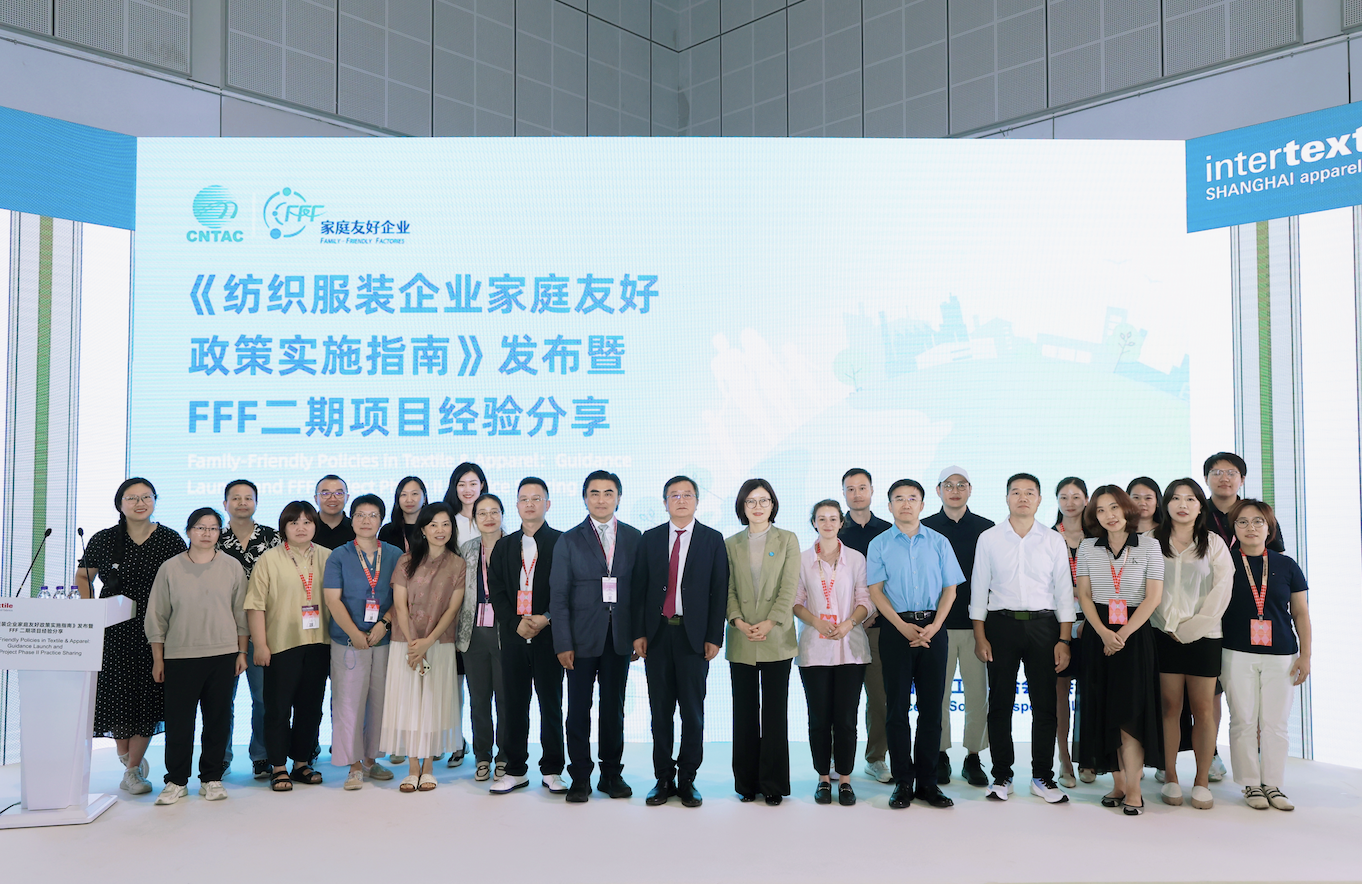
On August 26, the release of the Guidelines for the Implementation of Family-Friendly Policies in Textile and Apparel Enterprises and the FFF Phase II experience-sharing event were held at the National Exhibition and Convention Center (Shanghai). The event was hosted by the China National Textile and Apparel Council (CNTAC).
Industry consensus
The “Family Friendly Factory (FFF)” project is committed to creating a more inclusive working environment in the textile and apparel industry, enhancing employees’ cohesion, sense of happiness, and improving the competitiveness of the textile industry. It is very significant to the sustainable development of the industry.
The event summarized the practical achievements of the FFF Phase II project and released the official version of the Guidelines for the Implementation of Family-Friendly Policies in Textile and Apparel Enterprises.
At the opening of the event, Yan Yan, Vice President of CNTAC, said in her remarks that the textile and apparel industry is an important industry for people’s livelihood and plays a prominent role in stabilizing employment, promoting innovation, and expanding consumption. She expressed the hope that more enterprises would use more complete systems and warmer support to enhance employees’ happiness, and belonging, and consolidate the talent foundation for high-quality development of the industry.
Cheng Jin, UNICEF expert in social welfare (care economy) and ESG governance, said that family-friendly policies are not only employee welfare policies, but also child development policies, gender equality policies, and human capital investment policies. She called for incorporating family-friendly policies into ESG disclosure and corporate governance, and stressed that investing in families is investing in the future, and supporting children is supporting sustainable development.
Standard evolution

At the event, Dr. Liang Xiaohui, Deputy Chief Economist of the China Textile Information Center and expert and Vice-Chair of the UN Expert Mechanism on the Right to Development, delivered a keynote speech titled “From Past and Present to the Future: The Evolution of S-Dimension Standards and ESG Rebalancing under Supply Chain Legislation.” He said that the sustainable development of enterprises cannot be achieved without attention to people, and that improving the protection of workers’ rights and interests, improving the working environment, and responding to the needs of employees and their families are important components of corporate social responsibility.
Project results
At the event, Zheng Jian, International Project Director of the Social Responsibility Office of CNTAC, presented a report on the results of the Phase II project and released the official version of the Guidelines. The release of the Guidelines is a further summary and distillation of the project’s practical experience. It will provide textile and apparel enterprises with more systematic reference for identifying employee needs, improving family-friendly policies, and promoting the implementation of related measures, so that the family-friendly concept can be better integrated into corporate management.
Making family-friendly outcomes come true
Focusing on the application and practice of the Guidelines, three Phase II pilot enterprises Dongguan Feili, Bosideng Changshu, and Ningbo Beilun Jieteng shared their results. The enterprises said that, in response to various needs of employees’ families, they had carried out multiple flexible measures, including critical illness support, anti-domestic violence mechanisms, summer childcare programs and setting up lactation rooms, etc.
Creating a sustainable future for the textile industry
At the end of the event, Hu Songjiang, Director of the China Textile Information Center, delivered a summary. He said that the advancement of the FFF Phase II project has further moved the family-friendly concept from advocacy to corporate practice, and gradually integrated it from a single employee welfare measure into corporate institutional development and daily management. He hoped that the event would serve as an opportunity to encourage more enterprises to participate in family-friendly development, let the family-friendly concept take root in more workplaces, and contribute to stabilizing the industrial workforce, promoting high-quality full employment, and advancing the sustainable development of the textile and apparel industry.
Feb 10,2026